Paver patio installation in Indianapolis
We build patios, walkways and steps from Belgard concrete pavers, laid on a compacted base and finished with a border course. Every paver patio we install carries a lifetime warranty on the material and our work.
- Belgard Authorized Contractor
- Lifetime patio warranty
- Samples brought to your house
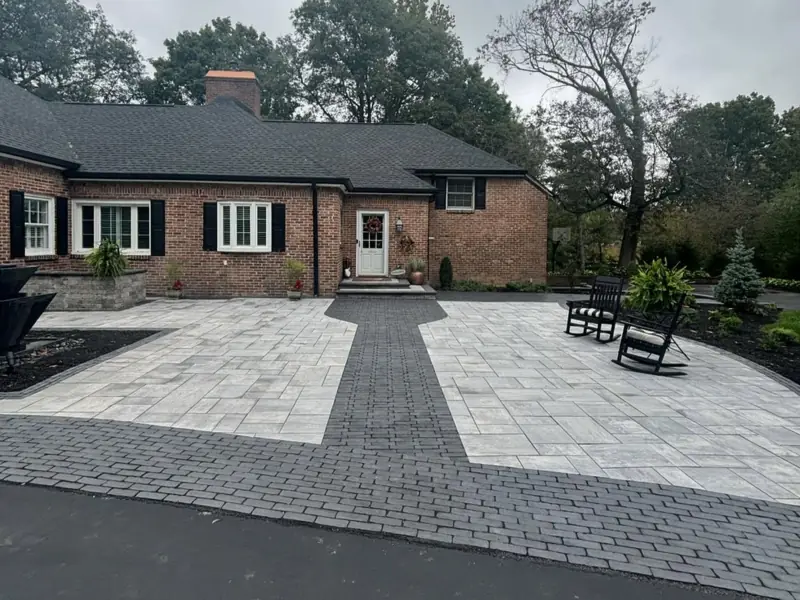
What we mean by a paver patio
A paver patio is hundreds of individual concrete pavers set tight on a compacted base and locked together with polymeric sand in the joints. We install Belgard pavers, and we're a Belgard Authorized Contractor. Because each paver is its own piece, the patio can flex a little as the ground moves through an Indiana winter instead of splitting the way one big poured slab does. That's why we can stand behind a paver patio for life.
A patio usually needs the pieces that get you to and from it: a walkway from the driveway, a path along the side of the house, or steps up to the back door. We treat steps as part of the patio, not a separate project, so the treads, the landing and the patio surface all match.
Concrete patio pavers vs. a poured concrete slab
People hear "concrete pavers" and picture a sidewalk. They're a different product. Concrete patio pavers are made in a factory, pressed and cured to a consistent strength, and come in set shapes, textures and colors. A poured slab is mixed and finished on site as one piece, and when it cracks, the crack is there for good. Our pavers won't crack the way a slab does, and a paver that ever settles can be lifted and reset without breaking anything around it. We lay out the whole comparison on our pavers vs. poured concrete page.
How we go about installing patio pavers
- Walk the yard and lay it outWe measure, check where water runs off the roof and the lawn, and mark the shape with you so the patio fits how you'll use it.
- Dig out and build the baseWe remove the sod and soil, then bring in base stone and compact it in layers. The base is the part you never see, and it's what keeps the surface flat for decades.
- Set a level bed and lay the fieldThe pavers go down in the pattern you picked, with a slight slope away from the house so rain runs off.
- Cut and set the border courseA soldier course of a contrasting paver runs around the edge. It frames the patio and holds the field pavers in place.
- Sand the joints and clean upWe sweep polymeric sand into every joint, mist it so it sets, and leave the yard the way we found it, minus the old patio.
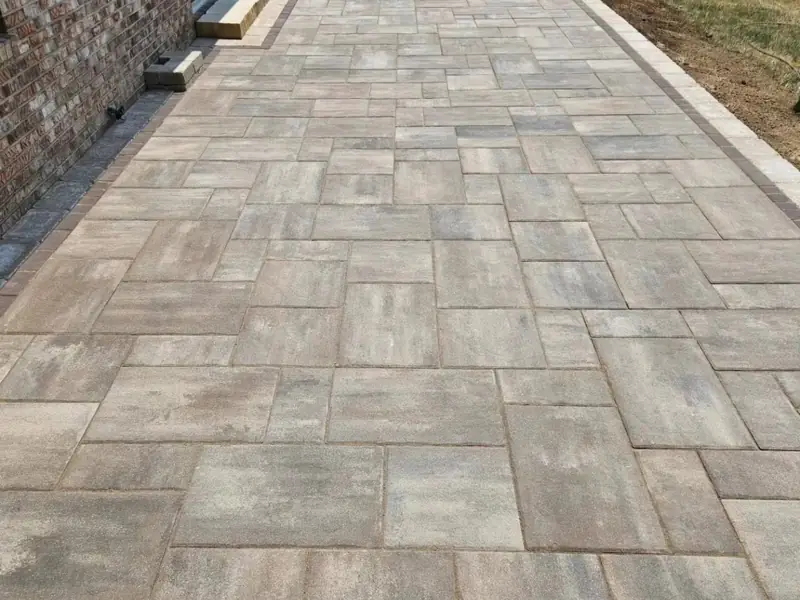
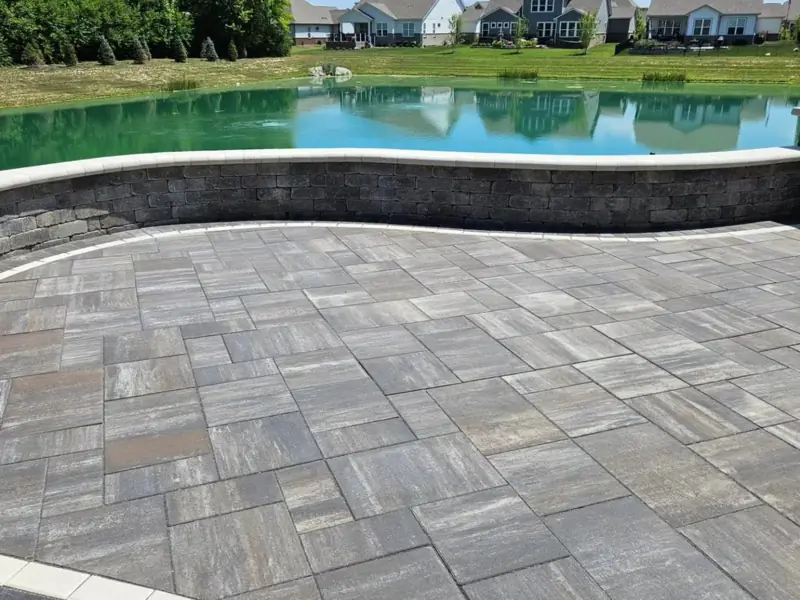
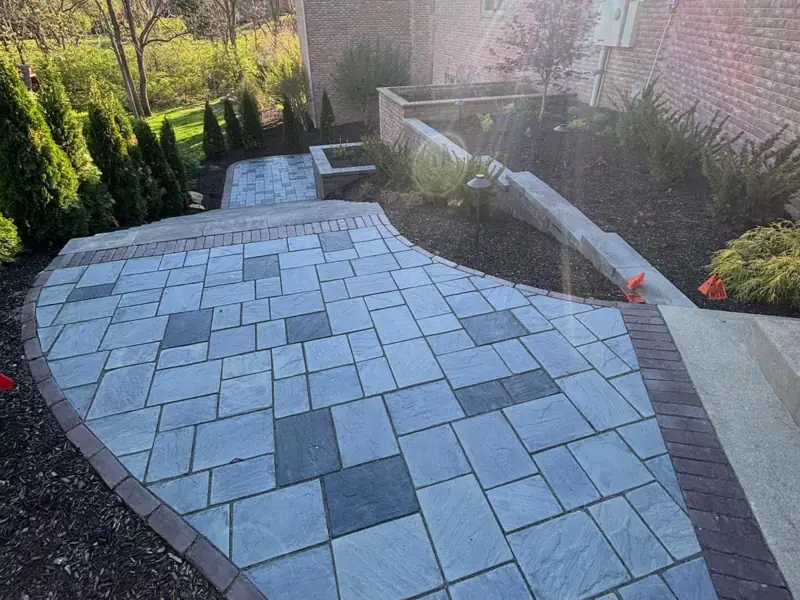
Patterns, colors and the border course
You'll see a contrasting border on almost every patio we build: charcoal around light gray, white around charcoal, a warm red around a blue-gray blend. That border course is what makes a patio look finished from the house. The field inside it can be a single large format, a mix of sizes, or a running pattern, and the color can stay quiet or tie into your brick or siding.
| Choice | What it changes | Where we see it work |
|---|---|---|
| Large-format pavers | Fewer joints, a calmer surface | Courtyards and modern homes |
| Mixed sizes | A hand-laid stone look | Brick ranches and older homes |
| Blended colors | Hides dirt and leaves, reads warmer | Walkways and busy family patios |
| Contrasting border | Frames the patio, locks the edge | Nearly every job we build |
Choosing from a brochure is hard, so we don't make you. Once you're narrowing it down, we bring two or three samples to your house so you can see them in your own light, next to your own house.
A favorite size, and room to grow
A patio around 600 square feet is one of our favorite jobs: big enough for a dining table, a couple of loungers and a fire pit, and still sized to the yard. Bigger and smaller both work. Our estimates are itemized, so you can build the patio now and add the fire pit, a sitting wall or cap lights later.
A patio is the one part of the yard you walk on every day for decades. We'd rather build it once and warranty it for life.Why every paver patio we install carries a lifetime warranty
Where we build them
We install paver patios all over Indianapolis and the towns around it. In the newer subdivisions of Carmel and Westfield, a patio often goes in behind a house that came with a bare yard and a small builder's slab. Not sure we come to your street? See every town we work in.
Paver patio questions
The pavers and our installation, for as long as you own the patio. The polymeric sand in the joints is the one piece that wears; it carries one year, and most patios need a fresh sweep of sand somewhere around year five to seven.
We look at it on site. A cracked or heaving slab usually comes out so we can build a proper base under the new patio. We'll explain what we find before we write the estimate.
Yes. Walkways and steps are part of our patio work, and we build them from the same pavers so the whole path to the patio matches.
Polymeric sand sets up firm in the joints, which keeps most weeds and ants out. We explain how it works on our paver joint sand page.
Goes well with a paver patio
Before you pick a paver
Let's size up your paver patio
We'll measure the space, talk through borders and colors, and bring paver samples to your house before you decide anything.
- We get back to you within 24 hours.
- The estimate is free and itemized, so you can pick what to build now and what to save for later.
- Robb or Zach walks the yard with you, and the same family builds it.