Pavers vs. a concrete patio: which one holds up in Indiana?
A poured patio is one big slab, so when the ground under it moves, it cracks. A paver patio is hundreds of interlocking pieces on a compacted base, so it flexes with the ground instead of splitting, and any paver that settles can be lifted and reset. That's why we can put a lifetime warranty on the paver patios we install.
What the ground under an Indianapolis patio does
Any patio is only as steady as the soil under it, and central Indiana soil keeps moving. Purdue's soils manual describes the Miami-Crosby-Brookston landscape of central Indiana, soils formed in glacial till, and the Hamilton County soil survey maps all three. Some of them hold water close to the surface: the USDA's official description of Crosby soil puts the top of its perched seasonal high water table at 0.5 to 2.0 feet down, and Brookston soil, found in low spots, can have water at or above the surface in the wet season.
Then winter arrives. Purdue researchers note that repeated freeze-thaw cycles weaken the bonds in soil. Wet ground, freezing and thawing over and over: that's the base every backyard patio around here sits on.
Why a paver patio flexes instead of cracking
A poured patio is one rigid piece. When the ground underneath shifts, even a little, the slab has nowhere to go, so it cracks. Saw-cut joints try to tell the crack where to happen, but they can't stop it.
A paver patio is built the other way around. We dig out, lay a compacted base, set the pavers in their pattern, and lock them together with polymeric sand swept into the joints. Each paver is its own piece, and the joints let the surface move a little without breaking. Our products won't crack the way a slab does. If one area ever settles, the pavers there come up and go back down on a re-leveled base.
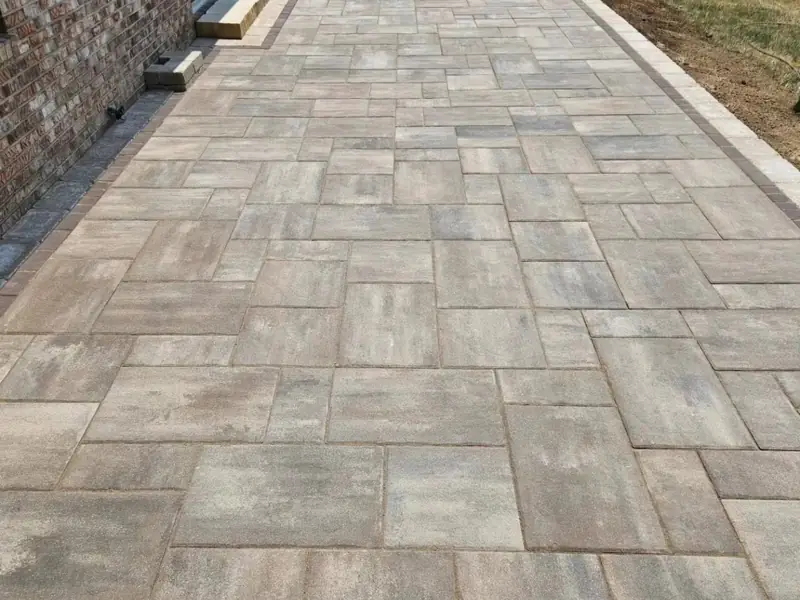
Pavers and a poured slab, side by side
Paver patio
- Hundreds of interlocking pieces on a compacted base
- Flexes with the ground through freeze and thaw
- A settled spot is lifted and reset
- Patterns, blends and contrasting border courses
- Lifetime warranty when we install it
Poured slab
- One rigid piece
- Cracks when the ground under it moves
- A crack is there to stay, or the slab gets broken out
- One color, one surface
- Joints control where it cracks, not whether
Repairs and upkeep
The one part of a paver patio that wears is the sand in the joints. Polymeric sand sets up firm but flexible, and it carries a one-year warranty from us. Expect to have the joints re-sanded somewhere around year five to seven. Our guide to polymeric sand in paver joints explains how it works and why we never use mortar between pavers.
Beyond the sand, a paver patio asks very little. The pavers themselves carry our lifetime warranty on material and installation.
Color, pattern and borders
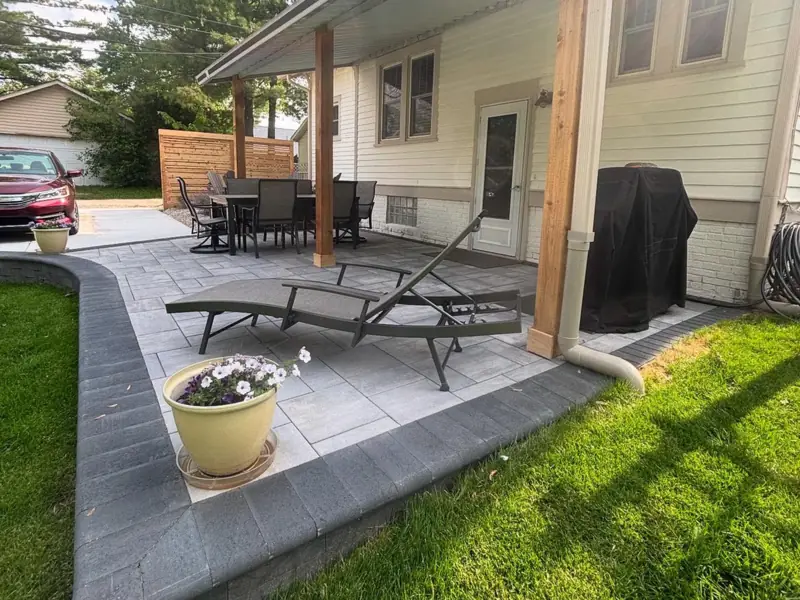
A slab is gray. A paver patio can be a light gray field with a charcoal soldier-course border, a blend of blues and grays, a tan running bond, or a hex pattern under a pavilion. We install Belgard pavers as a Belgard Authorized Contractor, and we bring two or three samples to your house so you can see them next to your brick or siding before you decide.
Questions about pavers vs. concrete
It's built to move a little without breaking. If a spot ever settles, the pavers there are lifted, the base is leveled, and they go back down. That's covered by our lifetime paver warranty.
Yes. A worn-out patio or stoop comes out, and the new base and pavers go in. The back porch in our before and after slider started with a crumbling brick and block stoop.
A compacted base underneath, an edge that holds the field in place, and polymeric sand in the joints that locks the pavers to each other.
Ready to see what a new patio would look like? Start with our paver patio installation page, or see the newer subdivisions where we build in Westfield.
After the slab question
Thinking about replacing a cracked patio?
Send a photo of what's there now. We'll walk it, tell you what a paver patio in that spot would look like, and email an itemized estimate.
- We get back to you within 24 hours.
- The estimate is free and itemized, so you can pick what to build now and what to save for later.
- Robb or Zach walks the yard with you, and the same family builds it.